LEGACY EVENTS FOR EDUCATION · COMMENTARY ON YOUTH DEVELOPMENT · PART 1 OF 2
OPINION & RESEARCH COMMENTARY — Personal opinion informed by published research. Not clinical advice. Consult a licensed mental health professional before acting on any suggestions herein.
PART 1 OF 2 · THE DIAGNOSIS
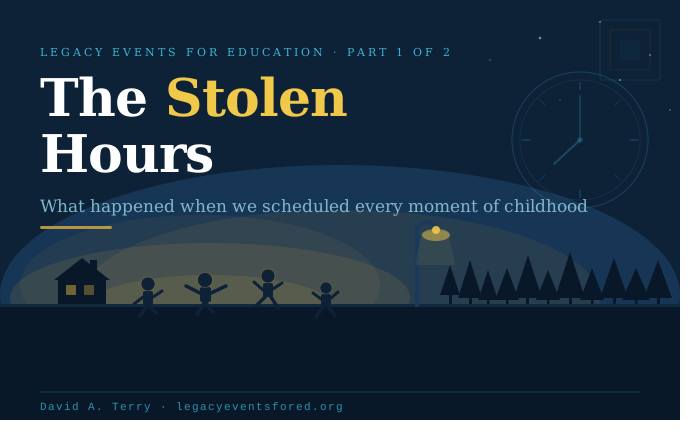
The Stolen Hours
What happened when we scheduled every moment of childhood — and what it produced in a generation of teens and young adults
David A. Terry · President, Legacy Events for Education · legacyeventsfored.org
Opinion & Research Commentary · 7 min read · May 2026
NOTE: This is my personal opinion, drawn from a review of published psychological research. I am not a clinician. Part 2 of this series covers what the research suggests about finding a way back — please consult a licensed mental health professional before acting on any of it.
“I’ve been reading the research on childhood, play, and mental health with growing unease — not because the findings are surprising, but because the implications are hard to sit with. We built a generation of children who were never really trusted with their own lives. And now those children are teenagers and young adults, and the evidence of what was missing is showing up in therapists’ offices, college counseling centers, and kitchen tables across the country.”
— David A. Terry, President, Legacy Events for Education
PART ONE
What Actually Happened to Childhood
The shift didn’t happen overnight. Gradually, across the late 1970s and through the 1980s and 90s, children stopped owning their time. Adults took it from them — not out of malice, but out of love, worry, and a cultural belief that a good parent fills every hour with something enriching and safe.
Before that shift, kids left after breakfast and came home when the streetlights came on. They built things, broke things, argued, got bored, invented rules, broke those too. There was no adult standing by to adjudicate conflicts. There was just life — unfiltered and fully theirs.
What replaced it — structured playdates, supervised activities, scheduled enrichment — came from a genuine place of care. The intentions were good. The consequences were not.
Boston College psychologist Peter Gray documented a steady fall in unsupervised activity beginning in the 1960s, running almost perfectly parallel to a steady rise in childhood anxiety, depression, and helplessness. [1] Gray argues this is not merely correlational but causal — free play is the primary mechanism through which children develop emotional self-regulation, conflict resolution, and what psychologists call an internal locus of control: the felt conviction that your choices shape your life.
A review by the American Psychological Association confirms it: play not organized by adults helps children build resilience and develop organic social competence that structured activities cannot replicate. [2] A 2022 systematic review in Frontiers in Psychology pinpointed when overprotective parenting took hold: around 1985, partly traced to the rise of the parent-supervised playdate. [3]
“By depriving children of opportunities to play on their own, away from direct adult supervision and control, we are depriving them of opportunities to learn how to take control of their own lives.”
— Dr. Peter Gray, Boston College · American Journal of Play, 2011
Jean Twenge’s meta-analysis at San Diego State — examining over 18,000 Americans across four decades — found that by 2002, the average young person felt more externally controlled than 80% of young people in the early 1960s. [4] In two generations, an entire culture shifted from “I shape my life” to “life happens to me.” That shift tracked directly with rising anxiety and depression.
UBC’s Dr. Mariana Brussoni reinforced why unstructured play matters physically too. Her 2015 systematic review of 21 studies found overwhelmingly positive effects when children could take physical risks — climb, explore, play without adult management — across health, creativity, social skills, and resilience. [5] A 2025 scoping review of 40 empirical studies extended those findings, consistently identifying resilience, wellbeing, and autonomy as benefits of unstructured environments. [6]
◆
PART TWO
What a Scheduled Childhood Actually Builds
The problem isn’t that structured activities are harmful. Music lessons and sports have real value. The problem is what gets crowded out when those activities occupy every available hour — the unstructured, self-directed time where the real developmental work happens.
When a child navigates a playground conflict without adult intervention, they learn to regulate emotions in real time. When they get bored and have to find their own way out, they build tolerance for discomfort. When they make a bad decision and live with it, they develop an internal locus of control. When all of that is replaced by adult-organized time, something essential doesn’t get built.
The research identifies a consistent cluster of outcomes. A 2016 longitudinal study from the National University of Singapore found that children with intrusive parents developed “maladaptive perfectionism” — a deep fear of making mistakes. [7] The 2022 Frontiers in Psychology review found links between helicopter parenting and increased anxiety, depression, lower self-regulation, and reduced self-efficacy. [3] A 2024 meta-analysis in the Journal of Adult Development confirmed a consistent positive association between helicopter parenting and anxiety and depression in emerging adults. [8]
In practice, these findings show up as recognizable patterns:
Chronic Anxiety
Persistent worry, often without a clear cause. The world feels threatening because they never had enough practice trusting themselves inside it. [1,3]
Decision Paralysis
Profound difficulty making choices. Having been told what to do for so long, genuine autonomy feels less like freedom and more like falling. [4]
Low Distress Tolerance
Difficulty sitting with boredom, frustration, or uncertainty. Research links play deprivation to rising ADHD prevalence and weakened self-regulation. [9]
Fragile Self-Efficacy
A shaky belief in their own competence — not because they aren’t capable, but because they have so little evidence of it. [10]
Avoidance Patterns
Steering away from situations that might involve failure or conflict. External locus of control correlates directly with avoidance-oriented coping. [11]
External Validation Hunger
A deep need for approval before acting. Childhood in adult-evaluated settings trains young people to look outward for the signal that things are okay. [4]
80%
A Generation’s Relationship With Control
By 2002, the average young American felt more externally controlled than 80% of young people in the early 1960s — and that shift tracked directly with rising anxiety and depression across the same period. (Twenge et al., 2004 [4])
Here is what I believe the research makes clear: none of this is a character flaw. If you recognize yourself in these patterns, you were not built wrong. Something simply was not built. That is a very different problem — and it has a very different solution. That solution is the subject of Part 2.
CONTINUE READING · PART 2 OF 2
Finding Your Way Back
What the research suggests teens, young adults, and parents can actually do — seven evidence-informed practices for rebuilding autonomy at any age.
RESEARCH REFERENCES
1. Gray, P. (2011). The decline of play and the rise of psychopathology in children and adolescents. American Journal of Play, 3(4), 443–463. https://files.eric.ed.gov/fulltext/EJ985541.pdf
2. American Psychological Association. (2023). The many wondrous benefits of unstructured play. https://www.apa.org/topics/children/kids-unstructured-play-benefits
3. Vigdal, J. S., & Brønnick, K. K. (2022). A systematic review of “helicopter parenting” and its relationship with anxiety and depression. Frontiers in Psychology, 13. https://pmc.ncbi.nlm.nih.gov/articles/PMC9176408/
4. Twenge, J. M., Zhang, L., & Im, C. (2004). It’s beyond my control: A cross-temporal meta-analysis of increasing externality in locus of control, 1960–2002. Personality and Social Psychology Review, 8(3), 308–319. https://journals.sagepub.com/doi/10.1207/s15327957pspr0803_5
5. Brussoni, M., et al. (2015). What is the relationship between risky outdoor play and health in children? A systematic review. IJERPH, 12(6), 6423–6454. https://pubmed.ncbi.nlm.nih.gov/26062038/
6. Scoping Review Team. (2025). Risky outdoor play and adventure education in nature for child and adolescent wellbeing: A scoping review. PMC / NIH. https://www.ncbi.nlm.nih.gov/pmc/articles/PMC12837311/
7. National University of Singapore. (2016). Intrusive parenting and maladaptive perfectionism. Cited in: Gottman Institute. https://www.gottman.com/blog/helicopter-parenting-good-intentions-poor-outcomes/
8. Padilla-Walker, L. M., et al. (2024). Parenting in overdrive: A meta-analysis of helicopter parenting. Journal of Adult Development. https://link.springer.com/article/10.1007/s10804-024-09496-5
9. AAP / Institute for Family Studies. (2022). A simple prescription for child well-being: More unstructured play. https://ifstudies.org/blog/a-simple-prescription-for-child-well-being-more-unstructured-play
10. Waldorf Education / ScienceDirect. (2022). Longitudinal Australian study (ages 2–7) linking unstructured play to self-regulation. https://www.waldorfeducation.org/the-essential-benefits-of-play-a-research-based-perspective/
11. IJFMR Research Team. (2026). The predictive role of coping strategies for locus of control among young adults ages 18–30. https://www.ijfmr.com/papers/2026/2/76514.pdf
David A. Terry · President, Legacy Events for Education · legacyeventsfored.org
Opinion informed by published research · Not clinical advice · Part 1 of 2